Meteor Scatter Makes DTV History
By Les Rayburn, N1LF
WTFDA member Rich McVicar, AB2FN, has earned a new place in the WTFDA DTV DX
Records with the first confirmed reception of a digital television station by meteor
scatter.
The reception occurred at 5:23:52 AM EST on November 5, 2023, and was captured
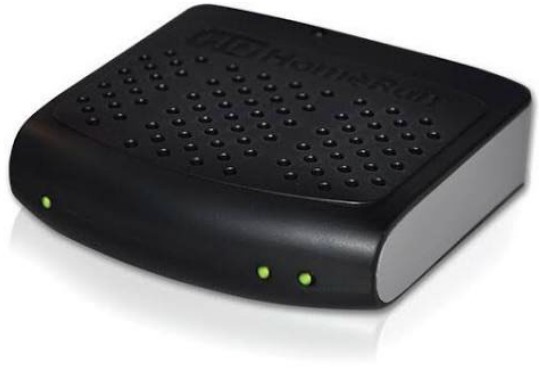
automatically by Rich’s HDHomeRun HDHR3 monitoring system. The receiver was
participating in the RabbitEars live-bandscan network, which automatically logs and
plots stations detected by participating tuners. WHBF in Rock Island, Illinois, a CBS
affiliate that serves the Quad Cities. It has an ERP of 33.7 kW and an antenna that is
1,330 feet HAAT. The transmitter is located in Bettendorf, Iowa.
Rich was asleep when it happened.
The November date and pre-dawn time are important clues to the propagation mode.
Sporadic-E would be highly unusual under those circumstances, while meteor scatter is
most productive during the early-morning hours, when Earth’s rotation carries the
observer into the direction of the planet’s orbital motion and encounters more
meteoroids.
There was another interesting coincidence: the Southern Taurid meteor shower was
active at the time, with its 2023 peak occurring around November 5.
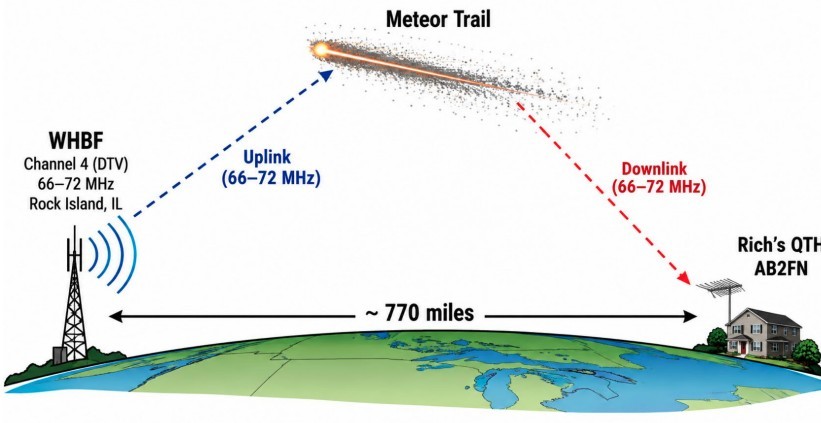
Digital television might seem an unlikely candidate for meteor-scatter DX because
individual meteor trails normally produce signals lasting only fractions of a second to
several seconds. But low-VHF television channels are particularly favorable territory for
meteor scatter. U.S. RF Channel 4 occupies 66–72 MHz, a 6 MHz-wide Low-VHF
channel.
That makes Rich’s reception especially plausible for meteor scatter. ~69 MHz sits in
very favorable territory for MS, considerably lower than the 88–108 MHz FM band
where meteor scatter is already routinely observed.
The HDHomeRun did more than simply detect RF energy. The station was successfully
identified and logged by the automated system, indicating that enough of the digital
signal was decoded to establish the station’s identity.
Rich remembers discovering the reception later on his RabbitEars page:
“I was fast asleep when the signal came in but was delighted when I saw it pop up on
my RabbitEars page.”
Rich’s reception establishes the first confirmed DTV meteor-scatter reception in the
WTFDA DX Records. It should not, however, be considered a once-in-a-lifetime feat.
Quite the opposite.
Low-VHF DTV remains fertile ground for experimentation, particularly Channels 2–6
during the hours before sunrise. Automated receivers also have a major advantage:
they can watch continuously for brief openings that a DXer sitting in front of the
television could easily miss.
Rich McVicar, AB2FN, has shown that it can be done.
Who will be next?